A savage attack on a 92-year-old Montreal woman on an STM adapted transit taxicab back in November is leading to calls for changes in the way passengers are assigned to the vehicles.
On Nov. 11, Hanka Fogelman, a Holocaust survivor, boarded an STM-commissioned adapted transit taxi to visit her daughter. Adapted transit buses or taxicabs are for those with mobility issues and people with either physical or mental disabilities, and the cabs are often shared with other passengers.
In this instance, there was another man in the backseat. As soon as she boarded, the driver warned her about the man, saying he was aggressive and could be dangerous.
At that moment, he was apparently quietly writing on a piece of paper. Moments later, he began to attack her, without warning, and without provocation. Fogelman was left with two black eyes, a broken nose — and a shattered sense of security.
"Her bruises are healing. Her physical appearance...she looks wonderful again. But inside, the scars haven't healed yet," Fogelman's daughter, Debbie Rona, told CJAD 800's Andrew Carter. "She doesn't feel strong, she feels very vulnerable. And this comes from a woman who's a Holocaust survivor that I've never seen any vulnerability from. I've always seen strength and courage."
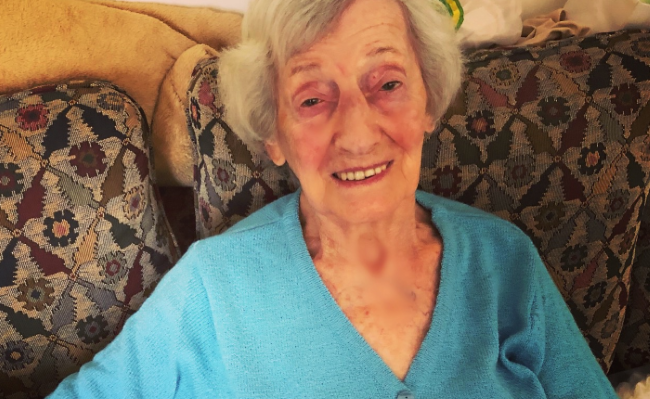
Hanka Fogelman on Dec. 14, the day she was released from hospital. (Courtesy of Debbie Rona)
'Unfortunate, unpredictable': STM
A statement from the STM called the incident "unfortunate, but also unpredictable," but "fortunately, very rare." But Rona told Andrew Carter that neither the STM nor Montreal police did very much at all to follow up on the attack.
"To me, it is utterly irresponsible that his attack on my mother wasn't followed up in any way," Rona says. "We were told that basically the file was basically sitting on a desk and hasn't been investigated. Nothing was done by the police and nothing was done by the STM."
Police never charged the attacker, citing the attacker's apparent mental disability.
Meanwhile, a spokesperson for RAPLIQ, an advocacy group for people with mobility issues, says elderly patients like Fogelman shouldn't have been allowed to ride with someone with mental issues at all.
Linda Gauthier says her group hears about several instances of misconduct or attacks on adapted transit vehicles per year.
"Last year we received four complaints. You might say that's not a lot, but that's only for us, the RAPLIQ, so I guess other organizations have received complaints as well," Gauthier says. "Or many people don't say anything about it. I think it's a lot. It's too much."
Gauthier says the STM is only following guidelines from the Quebec transport ministry, and is calling on the ministry to revise those guidelines to make sure people with mobility issues aren't allowed to share cabs with people who are potentially dangerous.